
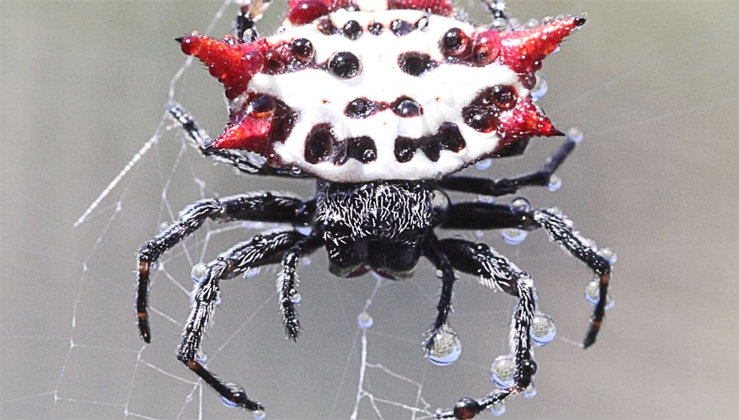
Discover the vibrant, spiny, and utterly fascinating world of orb-weaver spiders like Gasteracantha and Micrathena. These brilliantly colored arachnids are masters of web design and natural defense.
Orb-weavers belong to the spider family Araneidae, one of the largest arachnid families, encompassing more than 2,800 species spread across over 160 genera. Best known for their beautifully symmetrical spiral webs suspended between branches or shrubs, these spiders are common garden inhabitants. But among them, a few dazzling exceptions steal the spotlight with flamboyant appearances and fascinating behaviors.
-Gasteracantha: The Thorny-Bellied Spiders
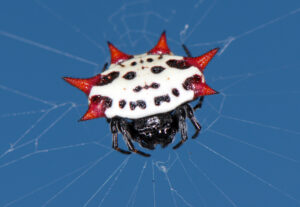
The genus Gasteracantha, meaning “thorn belly” in Greek (from gaster for belly and acantha for thorn), lives up to its name spectacularly. Among the most eye-catching is the spinybacked orb-weaver (Gasteracantha cancriformis), a tiny but mighty native to the Americas. This spider sports a wide array of common names—including crab-like spiny orbweaver, jewel spider, and smiley face spider—owing to its bright colors and crablike shape. Despite their formidable looks, these spiders are harmless to humans and play an essential role in controlling insect populations.
-Macracantha arcuata: The Longhorn of the Spider World
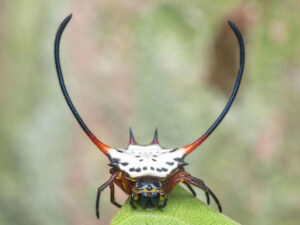
A close relative within the orb-weaver clan is the long-horned orb-weaver (Macracantha arcuata), also called the curved spiny spider. Its most distinct features are the dramatically elongated lateral spines that resemble insect antennae. This species, originally native to Southeast Asia and India, has made its way to parts of the southeastern United States, likely through accidental introduction. The spider’s unique shape serves as both camouflage and deterrent against would-be predators.
-Micrathena breviceps: Warning in Color
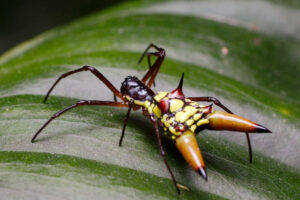
The genus Micrathena includes some of the most visually striking orb-weavers in the tropical Americas. One particularly fascinating species, Micrathena breviceps, lives in Costa Rica and is known for its arrow-shaped body and bold coloration—bright yellow on black. Naturalist Philip Davidson describes this as aposematic coloration, a biological warning signal to potential predators. Should a bird ignore the warning, it’s in for an unpleasant surprise: the spider’s spines lodge in the bird’s bill, while the spider secretes a foul-tasting substance. The resulting lesson leaves the bird with a lasting aversion to anything bearing those high-contrast hues.
Small Size, Big Impact
While they may appear fierce, spiny orb-weavers are typically very small. Even the largest among them rarely exceed 1.2 inches from spine to spine. Most are significantly tinier, often overlooked despite their flamboyant designs. These tiny terrors pose no danger to humans, and their presence in ecosystems around the globe—especially in tropical forests—underscores their ecological importance as insect predators and silk engineers.
Keep an Eye Out
If you’re wandering through a tropical rainforest in Asia, Africa, or the Americas—or even strolling through a garden in the southeastern U.S.—look closely among the leaves. You might just spot one of nature’s most ornate arachnids. Whether you admire them for their beauty, their engineering, or their evolutionary brilliance, spiny orb-weavers are a mesmerizing reminder of the wild creativity found in the natural world.