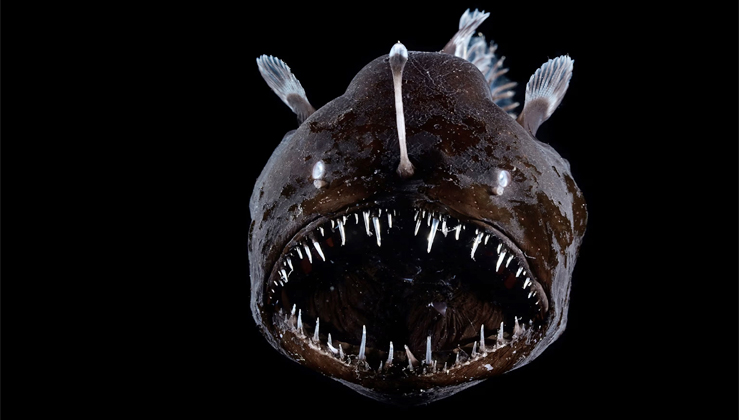
In a once-in-a-lifetime sighting, scientists have captured rare footage of a black seadevil anglerfish swimming near the ocean’s surface—a haunting and extraordinary glimpse of a deep-sea species seldom seen alive.
Rare Black Seadevil Filmed Alive in Historic Deep-Sea Encounter
For the first time in history, scientists have documented a living black seadevil anglerfish (Melanocetus johnsonii) ascending from its natural habitat in the deep sea to near-surface waters. The stunning footage was captured on January 26 by researchers aboard the research vessel Glaucus near the Canary Islands, a region known for its volcanic activity and rich marine biodiversity.The rare sighting has captivated the marine biology community. David Jara Bogunyà, a marine photographer with the NGO Condrik Tenerife, described the experience as surreal. “When I was a child, I was obsessed with illustrated books of deep-sea creatures. I never imagined I’d see one alive,” he shared.
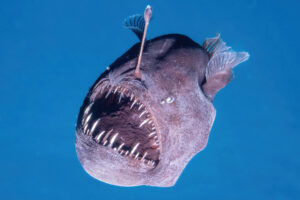
Over the course of nearly an hour, Jara and his team swam alongside the six-inch-long fish—armed with camera equipment—documenting every moment of its ghostlike swim. The black seadevil, named for its ominous appearance and bioluminescent lure, typically resides at crushing depths ranging from 650 to 6,500 feet below the ocean’s surface.Characterized by a gaping mouth, needle-sharp teeth, and a glowing lure that dangles from its head, the seadevil’s fearsome look masks its delicate physiology. “They seem terrifying, but in reality, they’re incredibly soft-bodied and fragile,” notes Dr. Kory Evans, a fish biologist at Rice University. “They’re designed for stillness, for ambush. Seeing one actively swimming is almost unheard of.”
Only one other recording of a living black seadevil exists: footage captured in 2014 by Bruce Robison and his team at the Monterey Bay Aquarium Research Institute using a remotely operated vehicle at a depth of 1,900 feet. The recent sighting, however, raises questions. Why would a deep-dwelling fish rise so far up the water column? Robison suggests a few possible explanations. One scenario involves the anglerfish accidentally ingesting prey with a swim bladder or internal gas organ. As the gases expanded, they could have propelled the predator upward uncontrollably. Another possibility lies in the Canary Islands’ unique undersea geology. Warm, rising water from volcanic fissures may have carried the fish to shallower waters. Or perhaps the anglerfish had been captured or injured by a larger predator—such as a whale, sea lion, or even a jellyfish—and later released or escaped closer to the surface.
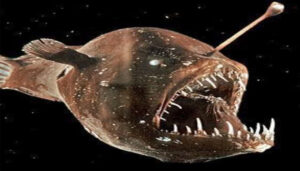
Though the fish died shortly after the encounter, its body was preserved and transferred to the Museum of Nature and Archaeology of Tenerife for scientific study.
“This event gives us a rare opportunity,” says Robison. “Until now, nearly everything we knew about this species came from deceased specimens recovered in trawl nets, many dating back over a century.”
Black seadevils are also fascinating due to their relationship with bioluminescent bacteria, which provide the eerie glow of their head-mounted lures. Some anglerfish species also reproduce in unusual ways, with males fusing to the female’s body and serving as a permanent source of sperm—a biological phenomenon known as sexual parasitism.
Evans, who recently published a study on anglerfish in the pre-print journal bioRxiv, notes that as these species migrated into the deep sea, their diversity surprisingly increased. “It’s the last place you’d expect to find such variation, given the harsh environment—immense pressure, scarce food, and complete darkness.” The black seadevil’s brief journey to the surface is a rare gift to science and a haunting reminder of how much we still don’t understand about our planet’s largest ecosystem.
“The deep ocean represents the biggest habitat on Earth, yet remains one of the least explored,” Robison concludes. “We’re only just beginning to glimpse the marvels it holds.”