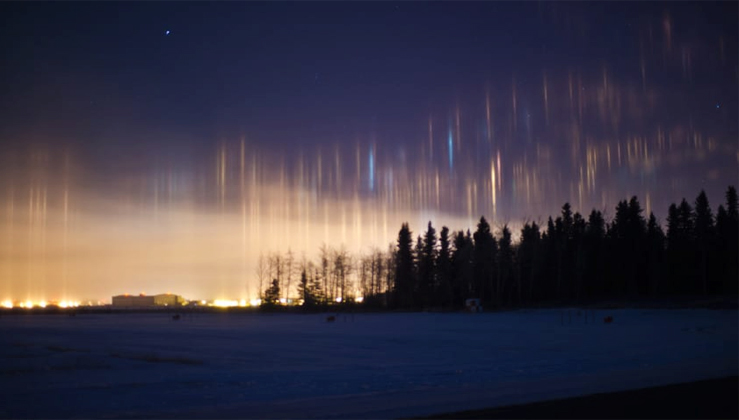
Light pillars are a rare winter phenomenon that occur when ice crystals in the atmosphere reflect light, creating glowing vertical beams in the night sky that look almost supernatural.
As winter deepens and frigid air grips the earth, many seek the comfort of warmth indoors. But on rare, freezing nights, the sky itself puts on a breathtaking display—one that resembles an alien world or a sci-fi fantasy. If you’re lucky enough to look up and see vertical shafts of glowing light piercing the night, you’ve just witnessed the extraordinary phenomenon known as light pillars.Though they appear otherworldly, light pillars are a remarkably straightforward natural occurrence. They’re created when hexagonal ice crystals form in the cold atmosphere and remain suspended in the air.
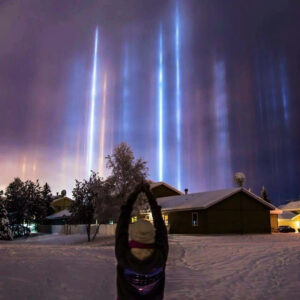
These flat, plate-like crystals act as mirrors, reflecting light from artificial sources such as street lamps, car headlights, or city lights. When viewed from the right angle, the reflected light stretches upward (and sometimes downward), forming brilliant columns of light in the sky.Light pillars can also occur in daylight, using the sun or even the moon as a light source, though they’re most commonly observed in dark skies over illuminated areas. Their colors can vary depending on the hue of the light being reflected—ranging from golden yellows and warm oranges to cool blues and whites—resulting in a dazzling, sometimes multicolored spectacle.What makes light pillars especially magical is their ephemeral nature.
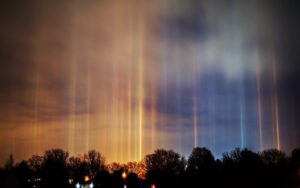
Like rainbows, they require specific conditions and can only be seen from certain vantage points. As the ice crystals shift with wind or temperature changes, the pillars fade, leaving behind only the memory of the surreal sight.These stunning columns have been photographed in places like Laramie, Wyoming, where soft ambient light created gentle, glowing towers above a quiet neighborhood. In other parts of the world—such as Stockholm, Sweden—the pillars have appeared as a map of all the urban light sources, dramatically revealing the interplay between man-made light and natural ice.
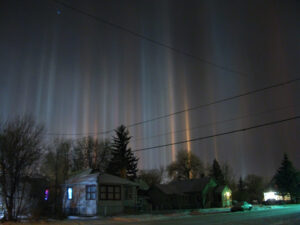
Unlike auroras, which are caused by charged particles from solar winds and occur only near the magnetic poles, light pillars can appear anywhere cold enough for ice crystals to form in the air. They don’t require any geomagnetic activity, making them more accessible to people across the globe, especially during the heart of winter. So the next time you venture out into the cold on a clear winter night, look up. If the conditions are right, you may be treated to one of nature’s most awe-inspiring tricks of the light—a celestial ladder of shimmering brilliance, reaching skyward and vanishing just as suddenly as it appeared.