Germany’s automotive giants are navigating turbulent times, and new threats from the U.S. could make matters worse. Leading manufacturers Volkswagen, BMW, and Mercedes-Benz have recently issued profit warnings, citing sluggish demand in China and broader economic challenges. Adding to these concerns, President-elect Donald Trump has pledged to impose tariffs on imports, potentially targeting Europe’s auto sector—a move that could disrupt Germany’s already struggling automotive industry.
On the campaign trail in Savannah, Georgia, Trump expressed his ambition to bring German car companies to U.S. soil. “I want German car companies to become American car companies. I want them to build their plants here,” Trump declared. Referring to tariffs as “music to my ears,” he reiterated his intent to reshape the global trade landscape.
While Trump’s initial tariff plans focus on China, Canada, and Mexico—proposing an additional 10% tariff on Chinese imports and a 25% tariff on goods from Canada and Mexico—European policymakers are bracing for potential impacts. Germany’s auto sector, already vulnerable, could be next in line.
German Auto Sector’s Vulnerabilities
Germany is Europe’s largest exporter of passenger cars to the U.S., with exports valued at €23 billion ($24.2 billion) in 2022, representing 15% of Germany’s total exports to the U.S., according to Eurostat and ING Research.
Rico Luman, senior economist for transport and logistics at ING, highlighted the interconnected nature of Germany’s auto sector, noting its deep links to the steel and chemical industries. “It’s the heart of the manufacturing industry,” Luman explained. “The whole supply chain could be affected.”
Profit warnings from Volkswagen, BMW, and Mercedes-Benz underscore the sector’s existing challenges. Both Volkswagen and BMW shares have declined by roughly 23% year to date, while Mercedes-Benz Group has seen a 13% drop.
German Car Companies Respond
Volkswagen has emphasized its North American operations, stating that 90% of the vehicles sold in the U.S. are produced locally and meet duty-free criteria under the USMCA trade agreement. However, Trump’s proposed tariffs could jeopardize the USMCA framework, creating uncertainty for automakers.
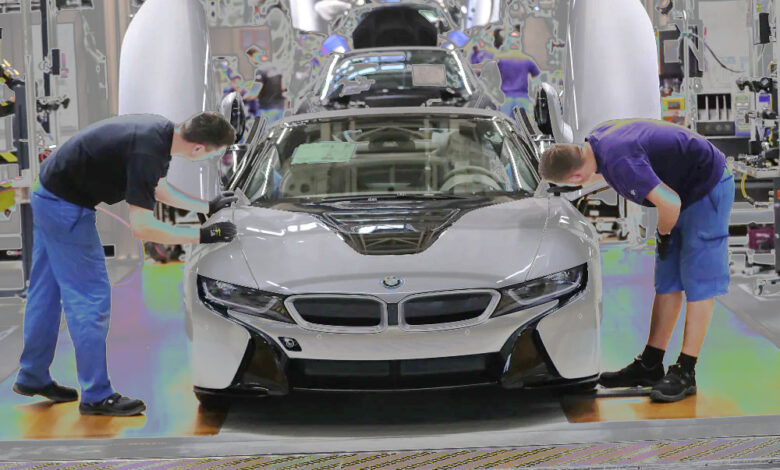
Mercedes-Benz employs over 11,000 workers across 12 U.S. locations and expressed its intention to engage constructively with the new administration. BMW, with a substantial footprint in the U.S., operates its largest production facility in Spartanburg, South Carolina. Despite these efforts, all three companies face significant risks if U.S. tariffs are introduced.
A European Perspective
Julia Poliscanova, senior director for vehicles and e-mobility at Transport & Environment, warned that Europe must brace for Trump’s trade policies. “Trump wants more tariffs, so everyone just needs to be ready,” she said.
Poliscanova emphasized that while German automakers may face short-term setbacks, Europe has an opportunity to accelerate its clean energy transition. “Trump risks putting America behind on clean tech and EVs, while Europe can push forward with its Green Deal and electrification agenda,” she said.
Preparing for the Challenges Ahead
As Trump’s trade policies loom, analysts are divided on the feasibility of his campaign promises. Michael Robinet, executive director of automotive consulting at S&P Global Mobility, noted the tight labor market in the U.S., which could complicate efforts to bring manufacturing stateside. “Unemployment is around 4%, so driving additional work in the U.S. is going to be problematic,” he said.
While uncertainties remain, Germany’s auto giants are taking steps to navigate the volatile landscape. However, the prospect of U.S. tariffs on European vehicles underscores the need for German manufacturers and European policymakers to prepare for potential upheaval.