Deep in East Africa, the continent is slowly splitting, revealing the birth of a future ocean in one of Earth’s most extreme and unique geological regions.
In one of Earth’s hottest and most geologically unique locations, East Africa’s Afar region is quietly revealing the dramatic forces shaping our planet. Here, along a desolate stretch of desert, a monumental transformation is underway: the African continent is gradually tearing itself apart. This slow-motion geological event is occurring along the East African Rift System, a vast tectonic boundary where three plates—the Nubian, Somali, and Arabian—are steadily drifting away from each other. The result? Scientists believe that, in 5 to 10 million years, a new ocean will emerge, dividing the eastern edge of Africa from the rest of the continent.
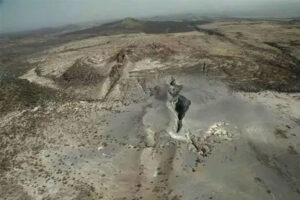
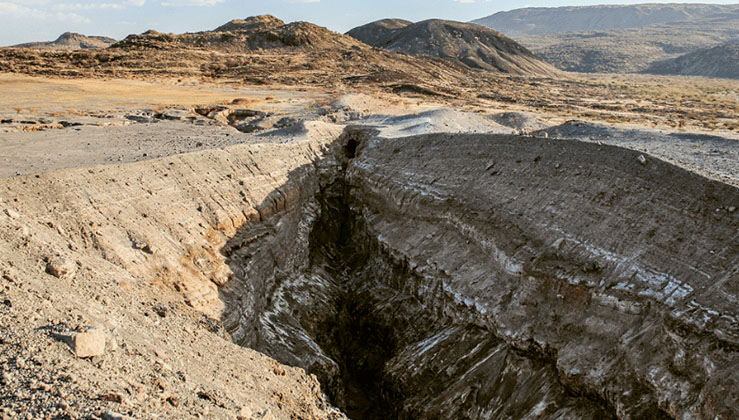
The clearest sign of this future ocean came in 2005, when a 35-mile-long crack violently tore through the Ethiopian desert. That event, equivalent to hundreds of years of tectonic plate motion happening within days, marked a rare opportunity for researchers to observe continental rifting in action. “This is the only place on Earth where you can directly study the transition from a continental rift to an oceanic rift,” said Christopher Moore, a doctoral researcher at the University of Leeds. He and other scientists are now using advanced satellite radar and GPS technology to monitor and measure the tectonic shifts beneath East Africa.
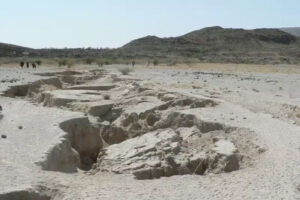
For the past 30 million years, the Arabian plate has been slowly drifting away from the African continent, forming the Red Sea and Gulf of Aden. But more recently, the Somali plate has started peeling away from the Nubian plate, causing a separation along the East African Rift Valley, stretching through Ethiopia and into Kenya. Researchers suspect a massive plume of superheated rock, rising from deep within Earth’s mantle beneath East Africa, may be fueling the rift. This plume may be weakening the crust, causing it to bulge and eventually fracture. “This region is an unparalleled natural laboratory,” said Ken Macdonald, marine geophysicist and professor emeritus at UC Santa Barbara. “Thanks to GPS, we can now measure plate movement down to just a few millimeters per year.”
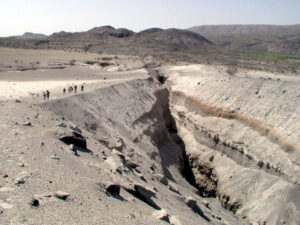
While this process is agonizingly slow, the Afar region’s geology gives clear indications of its tectonic future. Each of the three tectonic plates is moving at a different rate—the Arabian plate at roughly 1 inch per year, and the Somali and Nubian plates at 0.2 to 0.5 inches annually. Over time, these subtle movements will accumulate, tearing the land apart and allowing seawater to flood in. Despite the extreme heat—daytime temperatures in the Afar often reach 130°F—scientists like Cynthia Ebinger of Tulane University continue to conduct fieldwork here. Ebinger studied the 2005 fissure and concluded that some rifting events can occur in dramatic bursts rather than as a continuous process.
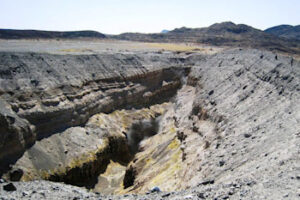
“We’re trying to understand what triggers these sudden ruptures,” she explained. Her research suggests that accumulating pressure from rising magma may be the tipping point, causing the ground to suddenly split when the stress becomes too much—similar to a balloon bursting when overinflated. As the plates diverge, magma from Earth’s interior rises and cools, forming new oceanic crust. This crust is denser and chemically distinct from continental rock, further indicating the emergence of a mid-ocean ridge system beneath the Afar. Eventually, scientists predict, the Red Sea and Gulf of Aden will breach the Afar depression and flood the East African Rift Valley, giving rise to a brand-new ocean and a new microcontinent. “It’s a rare glimpse into Earth’s tectonic evolution,” said Moore. “We’re literally watching a continent being split in two.”