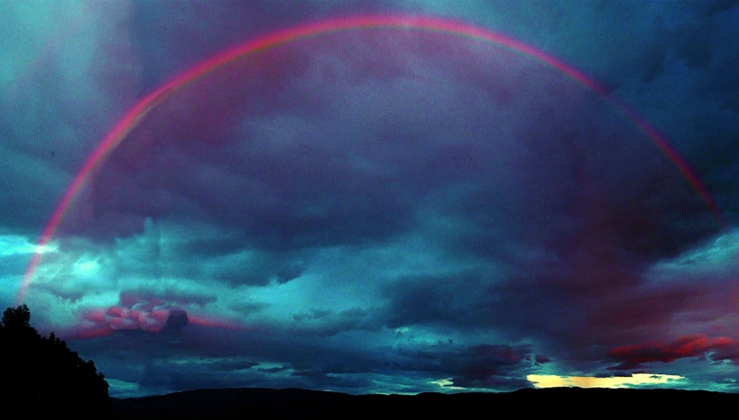
Moonbows, or lunar rainbows, are rare nighttime rainbows created by moonlight instead of sunlight—faint to the eye but stunning in long-exposure photos.
Moonbows: Rare Nighttime Rainbows Painted by the Moonlight
Everyone is familiar with the vibrant bands of a rainbow shining through after a storm—but did you know a similar spectacle can occur at night? These rare nocturnal wonders are called moonbows, or lunar rainbows, and instead of sunlight, they’re created by the faint shimmer of moonlight.
A moonbow forms in much the same way as a regular rainbow—when light is refracted and reflected through water droplets in the air.
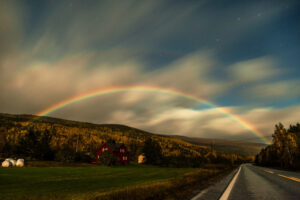
But unlike the blazing light of the sun, moonlight is much dimmer, making moonbows far less vivid and much more elusive. Because the Moon only reflects a fraction of sunlight, moonbows usually appear as white or grayish arcs to the naked eye. However, long-exposure photography reveals that they do in fact contain the full spectrum of colors. The existence of moonbows has been known since ancient times, dating back to mentions in Aristotle’s Meteorology around 350 BC. Yet despite this, they remain relatively unknown due to the rare and specific conditions required for their appearance.
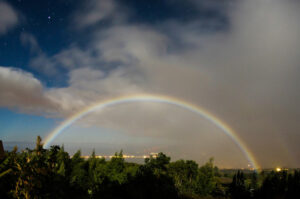
To witness a moonbow, several things must align perfectly:
-The Moon must be full or nearly full, offering maximum brightness.
-The sky must be very dark, with minimal light pollution.
-The Moon needs to be low in the sky, typically under 42 degrees above the horizon.
-There must be moisture in the air, such as rainfall, mist, or spray.
-The observer must be standing with their back to the Moon, looking toward the area of water droplets.
Given these constraints, moonbows are about ten times less common than their daytime counterparts. They are typically visible two to three hours after sunset or before sunrise, during the nights surrounding the full moon.
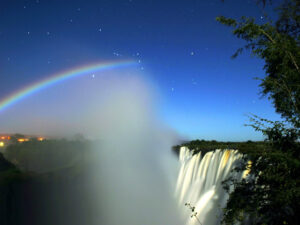
Winter full moons in high latitudes sometimes offer better chances, as the sky stays darker for longer and rain showers are more likely. Aside from rain, fog, mist, and waterfall spray can also produce moonbows. Several locations across the globe are known for their moonbow activity.In the United States, Yosemite Falls in California, Cumberland Falls in Kentucky, and Niagara Falls are reliable sites for sightings. Internationally, Victoria Falls—which borders Zambia and Zimbabwe—is world-renowned for hosting brilliant spray-induced moonbows during specific times of the year.
Want to catch a glimpse of a moonbow yourself? Look to the skies on a clear, humid night around the full moon. For the best view, visit a waterfall or misty environment, mount your camera on a tripod, and use a long-exposure setting. What looks like a soft white arc to your eyes will unveil breathtaking colors through the camera lens.