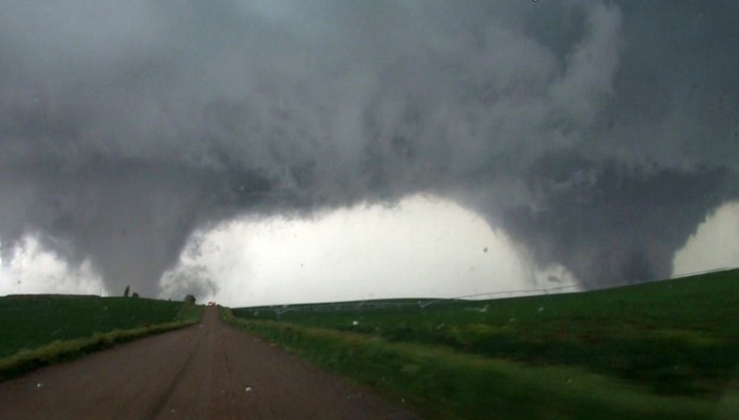
Discover how rare twin tornadoes form from a single supercell thunderstorm and the science behind their devastating power.
Twin tornadoes are among the most dramatic and destructive weather phenomena, capable of flattening entire towns in mere minutes. Though rare, these dual twisters can form under specific and extreme atmospheric conditions. While most tornadoes, whether solo or part of a larger outbreak, originate from supercell thunderstorms, twin tornadoes are unique in that both funnels stem from a single, powerful supercell. Supercells are intense storms with a rotating updraft known as a mesocyclone. These form when winds at different altitudes blow in varying directions and speeds, creating a spin that can birth tornadoes.
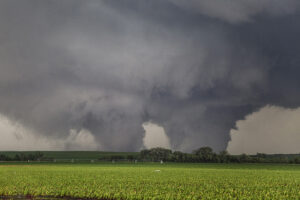
During major tornado outbreaks, it’s common for separate supercells to produce multiple tornadoes independently. But twin tornadoes are different—they develop from one storm system and are much more intertwined in their formation. Meteorologists have identified three primary mechanisms by which twin tornadoes can arise from a single supercell. The first is a process known as occlusion. In this scenario, a new tornado begins to form just as an older one starts to dissipate. For a brief window, both tornadoes exist simultaneously.
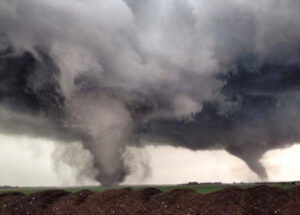
Meteorologist Greg Carbin explained to National Geographic that this overlapping phase is often part of a cyclic process, as seen in the devastating twin tornadoes that struck Pilger, Nebraska, on June 16, 2014. Karen Kosiba, a researcher with the Center for Severe Weather Research, described it as a “cyclic evolution,” where one tornado dies as another strengthens. The second mechanism involves the formation of a satellite tornado. In this case, a secondary twister spins up near the main tornado and rotates around it like a satellite orbiting a planet. These tornadoes are usually smaller but can still be extremely dangerous and add to the destruction. The third scenario unfolds during extremely violent supercells.
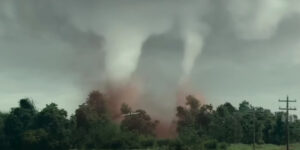
In such storms, the internal dynamics become so chaotic and energetic that smaller-scale vortices can break off from the main tornado. According to Carbin, this process involves intense internal turbulence, creating companion funnels within the same storm. Despite advances in radar, satellite imaging, and computer simulations, tornadoes—especially twin ones—remain difficult to predict and understand fully. Scientists continue to study them in hopes of improving forecasts and early warning systems. Twin tornadoes are extremely rare, appearing only once every 10 to 15 years. One of the most infamous events occurred in 1999, when a pair of tornadoes tore through Oklahoma City, causing widespread destruction and loss.