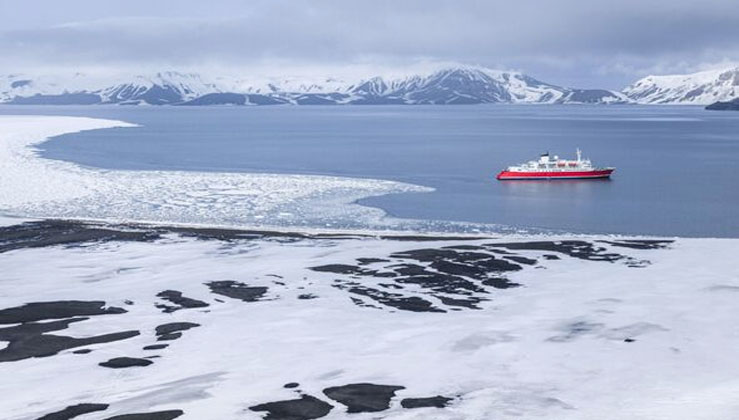
Deception Island, a volcanic island near the Antarctic Peninsula, features an astonishingly straight eastern shoreline and a rich history of exploration, industry, and geothermal oddities.
Tucked within the icy waters near the Antarctic Peninsula lies one of the planet’s strangest and most fascinating landforms—Deception Island. Though small in size, this circular island is geologically and historically rich, most notably featuring an unusually straight eastern coastline, a rare trait in the natural world. This long, linear stretch known as Costa Recta has captured the curiosity of geologists and travelers alike. Located in the Bransfield Strait, Deception Island is part of the South Shetland Islands and is actually the caldera of an active volcano. Shaped like a horseshoe, the island’s center has collapsed and flooded with seawater, forming Port Foster, a vast natural harbor that is surprisingly calm despite the volcanic activity beneath.
This makes it one of the safest harbors in Antarctica, accessible through a narrow 500-meter-wide entrance known as Neptune’s Bellows. What makes the island even more unique is the Costa Recta, the nearly straight eastern coastline, which scientists believe is a scarp formed by a retreated submarine fault—an incredible example of geological forces shaping the land in a way that appears artificially straight. The island’s first confirmed sighting was in January 1820 by British sealers William Smith and Edward Bransfield, followed by a visit in November by American sealer Nathaniel Palmer, who named it “Deception Island” due to its misleading exterior—it looks like a normal island, but Neptune’s Bellows reveals it to be a ring around a flooded volcanic caldera.
Deception Island quickly became the center of Antarctic activity. During the early 19th century, it was a key location in the fur-sealing industry. At its peak, nearly 100 sealing vessels visited, but overhunting led to the industry’s collapse by 1825. In the early 20th century, the island saw a revival as a hub for the whaling industry, with hundreds of workers and up to 13 ships operating each season. In 1908, the British government claimed Deception Island as part of the Falkland Islands Dependencies, establishing postal services, a customs office, and even a small railway system. A cemetery—the largest in Antarctica—was also created, along with a radio station and magistrate’s house.
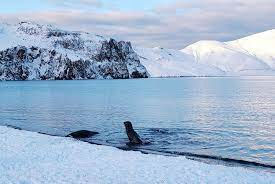
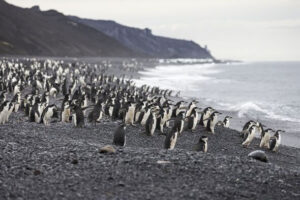
Mid-century scientific research stations were also established but were destroyed by volcanic eruptions in the late 1960s, leading to another period of abandonment. Today, the island is a popular stop on Antarctic cruises, drawing over 15,000 tourists annually. Visitors are drawn by its chinstrap penguin colonies, the remnants of historical buildings, and the island’s geothermal oddities. In volcanic areas, beach sand can reach 40°C, and digging into it creates natural hot baths, with water temperatures reaching up to 70°C. With its rare combination of geological perfection, historical significance, and biological richness, Deception Island stands out as one of the most bizarre and captivating places near the South Pole.