Archaeologists have uncovered an astonishing 8-mile stretch of Ice Age rock paintings deep in Colombia’s Amazon rainforest, depicting mastodons, giant sloths, and the first humans to settle the region.
A “Sistine Chapel” of Prehistoric Amazonia
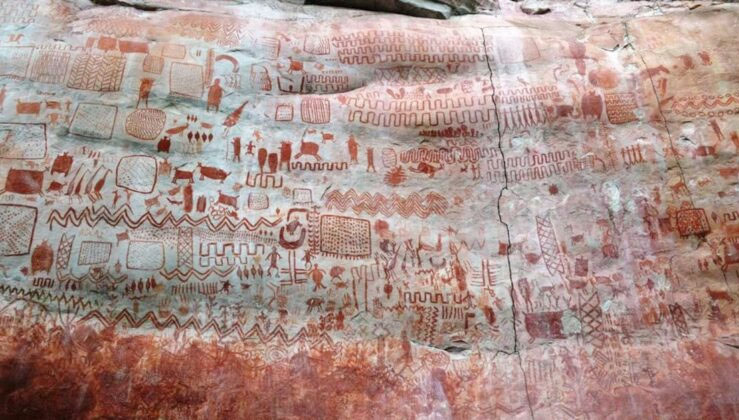
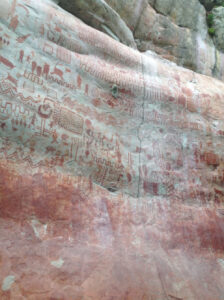
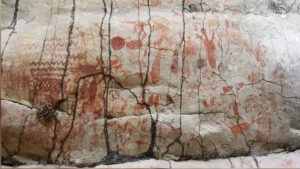
Deep in the heart of Colombia’s Amazon rainforest, researchers have revealed a monumental discovery: an eight-mile-long cliff face filled with Ice Age rock paintings. Dubbed the “Sistine Chapel of the Ancients,” the vast mural depicts long-extinct megafauna, intricate hunting scenes, and glimpses of human life at the end of the last Ice Age. The artwork, painted with ochre — a red clay pigment widely used in antiquity — covers rock walls above three shelters in the remote Serranía de la Lindosa region. Dating from about 11,800 to 12,600 years ago, the paintings capture the Amazon in transition from a mosaic of savannas and scrubland into the lush tropical rainforest we know today.
Discovery in a Remote Jungle
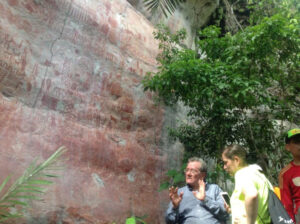
British and Colombian archaeologists first reached the site in 2017, after negotiating access with the Colombian government and local rebel forces. Even then, the team had to trek five hours through dense forest to reach the cliffs. The public is only now seeing these images for the first time, offering a rare glimpse into an ancient South American world. “This really is an incredible discovery,” said Mark Robinson, an archaeologist at the University of Exeter. “These images were created by some of the earliest people to live in western Amazonia, and they show us their world in extraordinary detail.”
A Lost World of Ice Age Giants
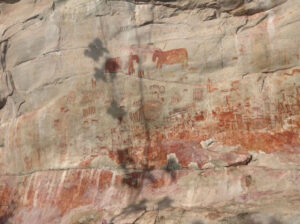
Tens of thousands of paintings crowd the cliff face. Familiar creatures — fish, lizards, porcupines — appear alongside extinct megafauna such as giant sloths, palaeolamas, and mastodons. Many of these animals roamed open savannas and thorny scrub rather than rainforest. Prehistoric humans appear, too, shown hunting, dancing, wearing elaborate masks, and engaging in rituals whose meaning is still debated. One striking motif shows people suspended or leaping from wooden platforms. Researchers think these structures may explain how ancient artists painted images far above human height on the sheer cliffs.
A Snapshot of Life at the End of the Ice Age
The Serranía de la Lindosa paintings provide a vivid record of human-animal interaction during a time of dramatic environmental change. “The Amazon hasn’t always looked like this,” noted archaeologist and explorer Ella Al-Shamahi, who visited the site. “Seeing Ice Age megafauna here is a marker of time, and a reminder that the landscape was shifting as humans arrived.” Bone and plant remains from the rock shelters reveal that these artists were early hunter-gatherers. Their diet included palm and tree fruits, piranhas, snakes, frogs, alligators, rodents such as paca and capybara, armadillos, and other animals of the prehistoric Amazon.
Clues to Early Amazonian Life and Culture
The LastJourney project — launched after the 2016 peace treaty between the Colombian government and FARC rebels — seeks to uncover when people first settled the Amazon and how they altered its biodiversity. José Iriarte, a co-researcher at the University of Exeter, believes the art was far more than decoration: “These paintings are spectacular evidence of how humans reconstructed the land. Art was likely a powerful part of their culture and a way to connect socially.” Although the pandemic has paused fieldwork, researchers are convinced that more prehistoric wonders await discovery in the surrounding rainforest. Each new find promises to deepen our understanding of the Amazon’s earliest inhabitants — and the wild world they called home.