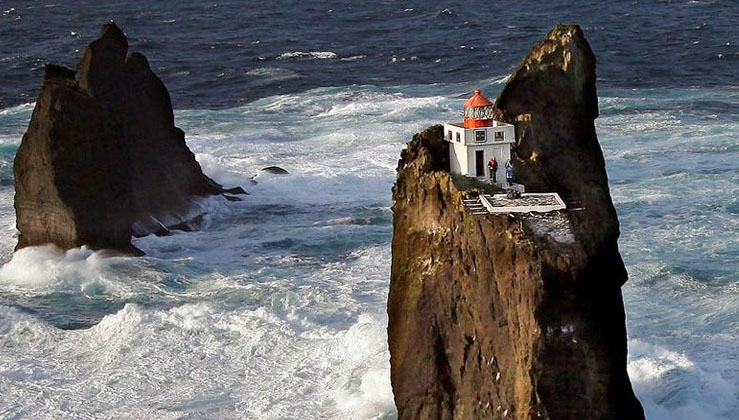
The breathtaking Þrídrangaviti lighthouse, clinging to a sea stack miles off Iceland’s coast, is one of the world’s most remote—and dramatic—lighthouses. A viral photo and a gripping history now shine new light on this engineering marvel.
A Lighthouse Suspended Between Sea and Sky
There are few lighthouses in the world as dramatically placed as Þrídrangaviti, a solitary beacon perched on a steep sea stack amid the North Atlantic’s merciless waves. Located nearly six miles from Iceland’s southern coast, it rises from the ocean like a monolith. The lighthouse seems to defy logic, clinging to a vertical cliff with no signs of human presence nearby—except for the tiny helipad added decades later. This jaw-dropping location is what drew the lens of Árni Sæberg, a veteran photographer for Morgunblaðið and Iceland Monitor. In 2009, he boarded a national coastguard helicopter, TF LÍF, and captured a now-iconic image of the lighthouse. Though remarkable at the time, the photo recently experienced a resurgence of fame when Justin Bieber shared it on social media, launching it into global virality. In fact, Sæberg wasn’t even aware of the widespread fame until his barber showed him the image on a German website.
The Pillars of Þrídrangar: Iceland’s Seafaring Sentinels
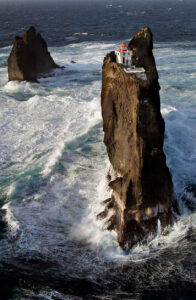
The lighthouse stands atop Stóridrangur, one of four sea stacks collectively known as Þrídrangar, meaning “three rock pillars”—though there are actually four: Stóridrangur, Þúfudrangur, Klofadrangur, and an unnamed fourth. The idea of constructing a lighthouse on these rugged cliffs was daring by any standard. With no helicopters available in 1939, the project demanded unimaginable physical effort. In 1938, a team of local Westman Islands mountaineers scaled the sheer rock face to build a rudimentary path to the summit. The story of how they reached the top is legendary: one man knelt on the rock, the next climbed on his back, and the third balanced atop both to grab hold of the upper edge of the cliff. It was teamwork on the edge of catastrophe. As Árni G. Þórarinsson, the project director at the time, recalled in an old interview, “I can’t even describe what I felt watching that moment. It was incredibly dangerous—but they did it.”
A Lighthouse That Inspired Stories and Imagination
Beyond its role in maritime safety, Þrídrangaviti has inspired literature and film. Icelandic thriller author Yrsa Sigurðardóttir used the lighthouse as a setting in her novel “Why Did You Lie?”, one of many works sparked by Sæberg’s haunting photographs. Another of his photos—featuring an abandoned farmhouse in the West Fjords—also inspired her novel I Remember You, later adapted into a film. These stories prove that Þrídrangaviti isn’t just a lighthouse—it’s a symbol of solitude, strength, and the enduring power of storytelling.
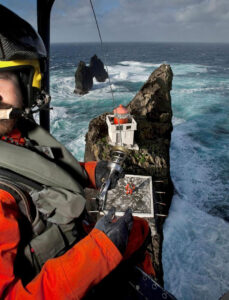
Standing Against the Storm
Today, the lighthouse remains a symbol of human perseverance in the face of nature’s extremes. While modern helicopters now allow occasional landings on the helipad built long after its original construction, the fact that this structure was built just before World War II—on a remote, wave-lashed pillar—is still almost unbelievable. Whether seen from the sky or in viral images spreading across the internet, Þrídrangaviti continues to stir the imagination of all who see it. As a guardian in the sea and a monument to human daring, this lighthouse will likely remain an Icelandic icon for generations to come.