Nature

Baobabs: Africa’s “Tree of Life” and the Myths, Marvels, and Challenges Surrounding It

Discover the legendary baobab tree—Africa’s “Tree of Life.” Explore its myths, ecological importance, uses for wildlife and humans, and the modern threats it faces.

Baobabs: An Upside-Down Legend
With swollen trunks and root-like crowns, baobabs seem to grow skyward from their roots instead of their branches. This peculiar shape gave rise to myths among the peoples living along the Zambezi River: some tell of angry gods ripping the tree from the earth and hurling it back down upside-down; others recount how God gave a baobab to a hyena, which disliked the tree’s looks and planted it the wrong way up. However it “arrived,” the baobab became one of the most recognizable symbols of Africa’s open landscapes.

Size, Strength, and Survival
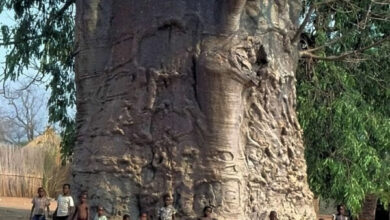
Baobabs can soar up to 100 feet tall, their girths reaching a staggering 165 feet, and some individuals live 3,000 years or more. They flourish in parched savannas and dry plains by storing thousands of liters of water in their enormous trunks. Their cork-like bark resists bushfires, and their far-reaching roots stabilize soil, slow erosion, and recycle nutrients—making them vital for both the land and life around them.

Resilient Reproducers
Although baobabs rely on pollinators such as fruit bats, bush babies, and in Madagascar, lemurs, the trees are remarkably regenerative. They can grow new bark after injury, heal wounds that would kill other trees, and continue standing even after hollowing out. Their blossoms, large and creamy white, open at night for just 24 hours, perfuming the darkness during or after the rainy season.

Fruit of the “Monkey Bread Tree”
Baobab fruit dangles like lanterns from long stalks—round to egg-shaped pods up to a foot long. Inside lies a chalky pulp packed with vitamin C, antioxidants like tartaric acid, and essential minerals. Baboons crack the shells for the tangy seeds (earning the tree the nickname “monkey bread tree”), while elephants tear into its moist interior to drink from its stored water during droughts.

A Global Family of Nine Species
Of the world’s nine baobab species, two are native to mainland Africa, six grow only in Madagascar, and one—known as the “boab”—thrives in northern Australia’s Kimberley and Northern Territory. All share the same distinctive silhouette and play essential roles in their local ecosystems.

Why the Baobab is Called the Tree of Life
More than 300 traditional uses have been recorded from baobabs’ bark, fruit, leaves, and pollen. Local people eat the tart pulp fresh or soaked as a drink, grind roasted seeds into a coffee-like beverage, and cook the leaves as a spinach substitute rich in magnesium and potassium. Traditional healers use baobab leaves for ailments such as asthma or insect bites. Bark fibers become rope, cloth, baskets, waterproof hats, and even strings for musical instruments. Flower pollen mixed with water forms a natural glue.
Each ancient baobab can shelter an entire micro-ecosystem—from bees and stick insects living in its hollows to antelope and warthogs feeding on fallen fruit. In ecological terms, baobabs are keystone species: without them, the biodiversity of surrounding savannas and dry forests would dramatically decline.

Threats to the Baobab Tree
Climate Change
Despite their size and age, baobabs are not invincible. Scientists suspect that climate change is accelerating the death of Africa’s oldest giants. Increased drought drives elephants to break into their trunks for water, sometimes fatally damaging the trees. Lightning and floods also take a toll. Creating wildlife corridors and additional water sources for elephants can relieve pressure on individual baobabs.

Deforestation
Madagascar has lost approximately 235,000 hectares of tree cover from 2010 to 2021, including vital baobab habitat. Initiatives such as WWF’s Forest Landscape Restoration (FLR) project work with communities to rehabilitate degraded land and develop sustainable, commercially viable restoration projects.

Agricultural Expansion
Species such as Madagascar’s iconic Grandidier’s baobab face severe threats from slash-and-burn farming, over-grazing, and soil erosion. Incentives for sustainable agriculture can help preserve baobab groves while supporting local livelihoods.

Famous Baobabs and Their Stories
Kondanamwali, Zambia
In Zambia’s Kafue National Park stands Kondanamwali—“the tree that eats maidens.” Legend says the giant baobab fell in love with four young women who rejected it for human husbands. In jealousy, the tree opened its trunk and swallowed them, where they remain forever.

The Avenue of the Baobabs, Madagascar
In western Madagascar, more than two dozen towering baobabs flank an 853-foot dirt road near Morondava. In 2007, the Avenue became the country’s first designated Natural Monument and is now a world-famous ecotourism site.

Sagole Baobab, South Africa
South Africa’s stoutest baobab rises in Limpopo Province, with a massive trunk and twisting limbs. Carbon-dated at about 1,200 years old (though locals claim twice that age), it houses a breeding colony of mottled spinetails, birds usually found along the West African coast.

Looking Ahead: Protecting an Ancient Legacy
Baobabs are living time capsules—sources of food, shelter, and myth for millennia. Safeguarding them requires international cooperation, from establishing wildlife corridors to restoring degraded forests and incentivizing sustainable agriculture. Without action, the next generation may inherit landscapes missing one of Earth’s most iconic trees.


İlgili Makaleler

Bir yanıt yazın

E-posta adresiniz yayınlanmayacak. Gerekli alanlar * ile işaretlenmişlerdir

Başa dön tuşu